中国器官移植AI辅助临床决策专家共识
摘要:
我国器官捐献与移植事业发展迅速,已跃居成为世界第二捐献与移植大国,但是器官移植数量和质量仍有待进一步提高,以满足广大等待移植受者需求。人工智能(AI)支持多源临床大数据的整合、分析与应用,能够辅助拓展可用供器官、提升移植物质量,为缓解移植器官供需失衡提供新的技术基础。为规范AI在我国器官捐献与移植全流程的辅助应用,现组织多学科专家制定《中国器官移植AI辅助临床决策专家共识》,通过构建统一的数据与模型要求,形成覆盖供者评估维护及器官匹配、器官保存与转运、器官移植手术和术后受者管理等全流程器官捐献与移植临床场景的技术框架,并规范伦理法规约束与责任主体边界,以进一步提升AI辅助器官捐献与移植工作的规范化、安全化水平,促进我国器官捐献与移植事业的高质量发展。
Abstract:
Organ donation and transplantation in China have developed rapidly, ranking second in the world in terms of both donation and transplantation volume. However, both the quantity and quality of organ transplants remain to be further improved to satisfy the demands of the vast number of recipients awaiting transplantation. Artificial intelligence (AI) facilitates the integration, analysis, and application of multi-source clinical big data. It is capable of assisting in expanding the pool of available donor organs and enhancing graft quality, thereby providing a novel technological foundation for alleviating the imbalance between the supply and demand of transplant organs. To standardize the auxiliary application of AI throughout the entire process of organ donation and transplantation in China, a team of multidisciplinary experts were convened to formulate the Chinese Expert Consensus on AI-Assisted Clinical Decision-Making in Organ Transplantation. By establishing unified requirements for data and models, this consensus forms a technical framework covering clinical scenarios across the entire workflow of organ donation and transplantation, including donor assessment and maintenance, organ matching, organ preservation and transport, transplant surgery, and post-transplant recipient management. Furthermore, it clarifies ethical and regulatory constraints as well as the boundaries of responsibility subjects. The aim is to further enhance the standardization and safety of AI-assisted organ donation and transplantation, ultimately promoting the high-quality development of this field in China.
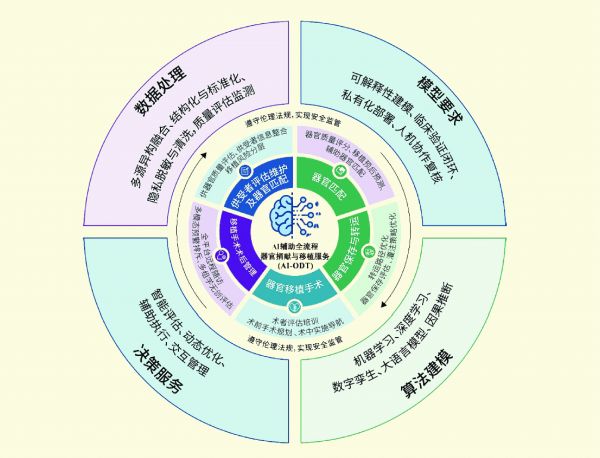
图 1 AI辅助全流程器官捐献与移植服务技术体系
Figure 1. AI-assisted full-process organ donation and transplantation service technology system
[1] 国家卫生健康委员会. 2022年国家医疗服务与质量安全报告[M]. 北京: 科学技术文献出版社, 2023. [2]ANDERSON D J, LOCKE J E. Progress towards solving the donor organ shortage[J]. Nat Rev Nephrol, 2023, 19(2): 83-84. DOI: 10.1038/s41581-022-00664-y.
[3]LOUPY A, PREKA E, CHEN X, et al. Reshaping transplantation with AI, emerging technologies and xenotransplantation[J]. Nat Med, 2025, 31(7): 2161-2173. DOI: 10.1038/s41591-025-03801-9.
[4]SPANN A, STRAUSS A T, DAVIS S E, et al. The role of artificial intelligence in chronic liver diseases and liver transplantation[J]. Gastroenterology, 2025, 169(3): 456-470. DOI: 10.1053/j.gastro.2025.05.012.
[5] 中华人民共和国国务院. 人体器官捐献和移植条例[EB/OL]. (2023-12-14) [2025-10-27]. https://www.gov.cn/zhengce/content/202312/content_6920195.htm. [6] 国家卫生健康委. 人体器官移植技术临床应用管理规定[EB/OL]. (2024-04-19) [2025-10-27]. https://zwfw.nhc.gov.cn/kzx/zcfg/yljgrtqgyzzyzgddsp_240/202408/t20240815_2832.html xxgkhide=1. [7]HOSSEINZADEH E, AFKANPOUR M, MOMENI M, et al. Data quality assessment in healthcare, dimensions, methods and tools: a systematic review[J]. BMC Med Inform Decis Mak, 2025, 25(1): 296. DOI: 10.1186/s12911-025-03136-y.
[8]RICHESSON R L, KRISCHER J. Data standards in clinical research: gaps, overlaps, challenges and future directions[J]. J Am Med Inform Assoc, 2007, 14(6): 687-696. DOI: 10.1197/jamia.M2470.
[9]YU M, KING K L, ALI HUSAIN S, et al. Discrepant outcomes between national kidney transplant data registries in the United States[J]. J Am Soc Nephrol, 2023, 34(11): 1863-1874. DOI: 10.1681/ASN.0000000000000194.
[10]FARRIS A B, MOGHE I, WU S, et al. Banff Digital Pathology Working Group: going digital in transplant pathology[J]. Am J Transplant, 2020, 20(9): 2392-2399. DOI: 10.1111/ajt.15850.
[11]PERAKSLIS E D, KNECHTLE S J, MCCOURT B, et al. Doing it right: caring for and protecting patient information for US organ donors and transplant recipients[J]. Patterns, 2023, 4(4): 100734. DOI: 10.1016/j.patter.2023.100734.
[12] 国家药品监督管理局. 人工智能医疗器械 质量要求和评价 第2部分: 数据集通用要求: YY/T 1833.2—2022[S]. 北京: 中国标准出版社, 2022. [13] 国家卫生健康委办公厅, 国家发展改革委办公厅, 工业和信息化部办公厅, 等. 关于促进和规范“人工智能+医疗卫生”应用发展的实施意见[EB/OL]. (2025-10-20)[2025-10-27]. https://www.gov.cn/zhengce/zhengceku/202511/content_7047018.htm [14]BHAT M, RABINDRANATH M, CHARA B S, et al. Artificial intelligence, machine learning, and deep learning in liver transplantation[J]. J Hepatol, 2023, 78(6): 1216-1233. DOI: 10.1016/j.jhep.2023.01.006.
[15]BENEVENTO E, ALOINI D, VAN DER AALST W M P. How can interactive process discovery address data quality issues in real business settings? evidence from a case study in healthcare[J]. J Biomed Inform, 2022, 130: 104083. DOI: 10.1016/j.jbi.2022.104083.
[16] 国家药品监督管理局医疗器械技术审评中心. 人工智能医疗器械注册审查指导原则[EB/OL]. (2022-03-10)[2025-10-27]. https://www.cncsdr.org/ggtz/ggzz/202203/t20220311_304188.html. [17] 中国医疗器械行业协会. 深度学习辅助决策医疗器械软件审评要点[EB/OL]. (2019-07-01)[2025-11-16]. https://www.mdcpp.com/doc/materialDownload/深度学习辅助决策医疗器械软件审评要点.pdf. [18] 国家药品监督管理局. 人工智能医疗器械质量要求和评价第3部分: 数据标注通用要求: YY/T 1833.3—2022[S]. 北京: 中国标准出版社, 2022. [19] 于兰亦, 翟晓梅. 人工智能在临床实践中的创新应用和伦理挑战[J]. 数字医学与健康, 2024, 2(2): 108-112. DOI: 10.3760/cma.j.cn101909-20231127-00073.YU L Y, ZHAI X M. Innovative applications and ethical challenges of artificial intelligence in clinical practice[J]. Digit Med Health, 2024, 2(2): 108-112. DOI: 10.3760/cma.j.cn101909-20231127-00073.
[20]EL-SAPPAGH S, ALONSO J M, RIAZUL ISLAM S M, et al. A multilayer multimodal detection and prediction model based on explainable artificial intelligence for Alzheimer’s disease[J]. Sci Rep, 2021, 11(1): 2660. DOI: 10.1038/s41598-021-82098-3.
[21]LAMY J B, SEKAR B, GUEZENNEC G, et al. Explainable artificial intelligence for breast cancer: a visual case-based reasoning approach[J]. Artif Intell Med, 2019, 94: 42-53. DOI: 10.1016/j.artmed.2019.01.001.
[22]LIU Y, YU W, DILLON T. Regulatory responses and approval status of artificial intelligence medical devices with a focus on China[J]. NPJ Digit Med, 2024, 7(1): 255. DOI: 10.1038/s41746-024-01254-x.
[23]KELLY C J, KARTHIKESALINGAM A, SULEYMAN M, et al. Key challenges for delivering clinical impact with artificial intelligence[J]. BMC Med, 2019, 17(1): 195. DOI: 10.1186/s12916-019-1426-2.
[24]SHEN T, LI Y, CAO Y, et al. Rapid deployment of large language model DeepSeek in Chinese hospitals demands a regulatory response[J]. Nat Med, 2025, 31(10): 3233-3238. DOI: 10.1038/s41591-025-03836-y.
[25]ROSCHEWITZ M, MEHTA R, JONES C, et al. Automatic dataset shift identification to support safe deployment of medical imaging AI[C]//Medical Image Computing and Computer Assisted Intervention – MICCAI 2025. Cham: Springer, 2026: 67-76. DOI: 10.1007/978-3-032-04981-0_7.
[26]BEDI S, LIU Y, ORR-EWING L, et al. Testing and evaluation of health care applications of large language models: a systematic review[J]. JAMA, 2025, 333(4): 319-328. DOI: 10.1001/jama.2024.21700.
[27]PAL A, UMAPATHI L K, SANKARASUBBU M. Med-HALT: medical domain hallucination test for large language models[C]//Proceedings of the 27th Conference on Computational Natural Language Learning (CoNLL). Singapore. Stroudsburg, PA, USA: ACL, 2023: 314-334. DOI: 10.18653/v1/2023.conll-1.21.
[28]NG K K Y, MATSUBA I, ZHANG P C. RAG in health care: a novel framework for improving communication and decision-making by addressing LLM limitations[J]. Nejm Ai, 2025, 2(1): 1-12. DOI: 10.1056/aira2400380.
[29] 国家卫生健康委办公厅, 国家中医药局综合司, 国家疾控局综合司. 卫生健康行业人工智能应用场景参考指引[EB/OL]. (2024-11-14) [2025-10-27]. https://www.nhc.gov.cn/guihuaxxs/c100133/202411/3dee425b8dc34f739d63483c4e5c334c.shtml. [30]MONTGOMERY A E, RANA A. Current state of artificial intelligence in liver transplantation[J]. Transplant Rep, 2025, 10(2): 100173. DOI: 10.1016/j.tpr.2025.100173.
[31]SCHATTENBERG J M, CHALASANI N, ALKHOURI N. Artificial intelligence applications in hepatology[J]. Clin Gastroenterol Hepatol, 2023, 21(8): 2015-2025. DOI: 10.1016/j.cgh.2023.04.007.
[32]TSCHUOR C, FERRARESE A, KUEMMERLI C, et al. Allocation of liver grafts worldwide–is there a best system?[J]. J Hepatol, 2019, 71(4): 707-718. DOI: 10.1016/j.jhep.2019.05.025.
[33]JEONG J G, CHOI S, KIM Y J, et al. Deep 3D attention CLSTM U-Net based automated liver segmentation and volumetry for the liver transplantation in abdominal CT volumes[J]. Sci Rep, 2022, 12: 6370. DOI: 10.1038/s41598-022-09978-0.
[34]SHAVER C M, REESE P P, GRIESEMER A, et al. Scientific advances in the assessment, modification, and generation of transplantable organs for patients with end-stage organ diseases[J]. Lancet, 2025, 406(10501): 376-388. DOI: 10.1016/S0140-6736(25)00239-9.
[35]BERRY P, KOTHA S. The fundamental importance of exploring the risks alongside the benefits of artificial intelligence[J]. J Hepatol, 2024, 80(5): e223-e225. DOI: 10.1016/j.jhep.2023.06.020.
[36]SCHWANTES I R, AXELROD D A. Technology-enabled care and artificial intelligence in kidney transplantation[J]. Curr Transplant Rep, 2021, 8(3): 235-240. DOI: 10.1007/s40472-021-00336-z.
[37]SENANAYAKE S, WHITE N, GRAVES N, et al. Machine learning in predicting graft failure following kidney transplantation: a systematic review of published predictive models[J]. Int J Med Inform, 2019, 130: 103957. DOI: 10.1016/j.ijmedinf.2019.103957.
[38]NAKAYAMA T, SASAKI K. Advanced viability assessment in machine perfusion: what lies ahead?[J]. EBioMedicine, 2024, 108: 105351. DOI: 10.1016/j.ebiom.2024.105351.
[39]WANG S, YANG M, LIU Y, et al. Aortic pressure control based on deep reinforcement learning for ex vivo heart perfusion[J]. Appl Sci, 2024, 14(19): 8735. DOI: 10.3390/app14198735.
[40]SAGE A T, DONAHOE L L, SHAMANDY A A, et al. A machine-learning approach to human ex vivo lung perfusion predicts transplantation outcomes and promotes organ utilization[J]. Nat Commun, 2023, 14(1): 4810. DOI: 10.1038/s41467-023-40468-7.
[41]DUMBILL R, KNIGHT S, HUNTER J, et al. Prolonged normothermic perfusion of the kidney prior to transplantation: a historically controlled, phase 1 cohort study[J]. Nat Commun, 2025, 16(1): 4584. DOI: 10.1038/s41467-025-59829-5.
[42]MANTECCHINI L, PAGANELLI F, MORABITO V, et al. Transportation of organs by air: safety, quality, and sustainability criteria[J]. Transplant Proc, 2016, 48(2): 304-308. DOI: 10.1016/j.transproceed.2015.12.050.
[43]TALMALE G, SHRAWANKAR U. Dynamic clustered hierarchical real time task assignment & resource management for IoT based smart human organ transplantation system[C]//2017 Conference on Emerging Devices and Smart Systems (ICEDSS). Mallasamudram, India. IEEE, 2017: 103-109. DOI: 10.1109/ICEDSS.2017.8073667.
[44]CAO Y, WANG Y, LIU H, et al. Artificial intelligence revolutionizing anesthesia management: advances and prospects in intelligent anesthesia technology[J]. Front Med, 2025, 12: 1571725. DOI: 10.3389/fmed.2025.1571725.
[45]CESARETTI M, BRUSTIA R, GOUMARD C, et al. Use of artificial intelligence as an innovative method for liver graft macrosteatosis assessment[J]. Liver Transpl, 2020, 26(10): 1224-1232. DOI: 10.1002/lt.25801.
[46]OH N, LIM M, KIM B, et al. AI-assisted intraoperative navigation for safe right liver mobilization in pure laparoscopic donor hepatectomy: an experimental multi-institutional validation study[J]. Sci Rep, 2025, 15(1): 27935. DOI: 10.1038/s41598-025-11627-1.
[47]CHEN X, XU H, QI Q, et al. AI-based chest CT semantic segmentation algorithm enables semi-automated lung cancer surgery planning by recognizing anatomical variants of pulmonary vessels[J]. Front Oncol, 2022, 12: 1021084. DOI: 10.3389/fonc.2022.1021084.
[48]BELLINI V, GUZZON M, BIGLIARDI B, et al. Artificial intelligence: a new tool in operating room management. role of machine learning models in operating room optimization[J]. J Med Syst, 2019, 44(1): 20. DOI: 10.1007/s10916-019-1512-1.
[49]SLAGTER J S, OUTMANI L, TRAN K T C K, et al. Robot-assisted kidney transplantation as a minimally invasive approach for kidney transplant recipients: a systematic review and meta-analyses[J]. Int J Surg, 2022, 99: 106264. DOI: 10.1016/j.ijsu.2022.106264.
[50]KHALIEL F H, HAQ M I, ALSULBUD A K, et al. “First-in-human” totally robotic orthotopic heart transplant[J]. J Heart Lung Transplant, 2025, 44(6): 1000-1003. DOI: 10.1016/j.healun.2025.02.1685.
[51]SONE K, TANIMOTO S, TOYOHARA Y, et al. Evolution of a surgical system using deep learning in minimally invasive surgery (Review)[J]. Biomed Rep, 2023, 19(1): 45. DOI: 10.3892/br.2023.1628.
[52]YILMAZ R, BAKHAIDAR M, ALSAYEGH A, et al. 828 real-time artificial intelligence instruction in comparison to human expert instruction in surgical technical skills teaching–a randomized controlled trial[J]. Br J Surg, 2023, 110(Supplement_7): znad258.077. DOI: 10.1093/bjs/znad258.077.
[53]LUONGO F, HAKIM R, NGUYEN J H, et al. Deep learning-based computer vision to recognize and classify suturing gestures in robot-assisted surgery[J]. Surgery, 2021, 169(5): 1240-1244. DOI: 10.1016/j.surg.2020.08.016.
[54]KIYASSEH D, MA R, HAQUE T F, et al. A vision transformer for decoding surgeon activity from surgical videos[J]. Nat Biomed Eng, 2023, 7(6): 780-796. DOI: 10.1038/s41551-023-01010-8.
[55]BAE S, MASSIE A B, CAFFO B S, et al. Machine learning to predict transplant outcomes: helpful or hype? a national cohort study[J]. Transpl Int, 2020, 33(11): 1472-1480. DOI: 10.1111/tri.13695.
[56]MALDONADO A Q, WEST-THIELKE P, JOYAL K, et al. Advances in personalized medicine and noninvasive diagnostics in solid organ transplantation[J]. Pharmacotherapy, 2021, 41(1): 132-143. DOI: 10.1002/phar.2484.
[57]SCARDONI A, BALZARINI F, SIGNORELLI C, et al. Artificial intelligence-based tools to control healthcare associated infections: a systematic review of the literature[J]. J Infect Public Health, 2020, 13(8): 1061-1077. DOI: 10.1016/j.jiph.2020.06.006.
[58]GRSKOVIC M, HILLER D J, EUBANK L A, et al. Validation of a clinical-grade assay to measure donor-derived cell-free DNA in solid organ transplant recipients[J]. J Mol Diagn, 2016, 18(6): 890-902. DOI: 10.1016/j.jmoldx.2016.07.003.
[59]O’CONNELL P J, ZHANG W, MENON M C, et al. Biopsy transcriptome expression profiling to identify kidney transplants at risk of chronic injury: a multicentre, prospective study[J]. Lancet, 2016, 388(10048): 983-993. DOI: 10.1016/S0140-6736(16)30826-1.
[60]WOILLARD J B, LABRIFFE M, DEBORD J, et al. Tacrolimus exposure prediction using machine learning[J]. Clin Pharmacol Ther, 2021, 110(2): 361-369. DOI: 10.1002/cpt.2123.
[61]LIPKOVA J, CHEN T Y, LU M Y, et al. Deep learning-enabled assessment of cardiac allograft rejection from endomyocardial biopsies[J]. Nat Med, 2022, 28(3): 575-582. DOI: 10.1038/s41591-022-01709-2.
[62]RAYNAUD M, AUBERT O, DIVARD G, et al. Dynamic prediction of renal survival among deeply phenotyped kidney transplant recipients using artificial intelligence: an observational, international, multicohort study[J]. Lancet Digit Health, 2021, 3(12): e795-e805. DOI: 10.1016/S2589-7500(21)00209-0.
[63]LOUPY A, COUTANCE G, BONNET G, et al. Identification and characterization of trajectories of cardiac allograft vasculopathy after heart transplantation: a population-based study[J]. Circulation, 2020, 141(24): 1954-1967. DOI: 10.1161/CIRCULATIONAHA.119.044924.
[64]OLAWADE D B, MARINZE S, QURESHI N, et al. The impact of artificial intelligence and machine learning in organ retrieval and transplantation: a comprehensive review[J]. Curr Res Transl Med, 2025, 73(2): 103493. DOI: 10.1016/j.retram.2025.103493.
[65]VIVEK K, PAPALOIS V. AI and machine learning in transplantation[J]. Transplantology, 2025, 6(3): 23. DOI: 10.3390/transplantology6030023.
[66]DE CANNIÈRE H, CORRADI F, SMEETS C J P, et al. Wearable monitoring and interpretable machine learning can objectively track progression in patients during cardiac rehabilitation[J]. Sensors, 2020, 20(12): 3601. DOI: 10.3390/s20123601.
[67]HASSAN M K, EL DESOUKY A I, ELGHAMRAWY S M, et al. A Hybrid real-time remote monitoring framework with NB-WOA algorithm for patients with chronic diseases[J]. Future Gener Comput Syst, 2019, 93: 77-95. DOI: 10.1016/j.future.2018.10.021.
[68]ENDO Y, SASAKI K, MOAZZAM Z, et al. Quality of ChatGPT responses to questions related to liver transplantation[J]. J Gastrointest Surg, 2023, 27(8): 1716-1719. DOI: 10.1007/s11605-023-05714-9.
[69]SINGLA R, LODHI S, KIBRET T, et al. Accuracy, clarity, and comprehensiveness of ChatGPT outputs for commonly asked questions about living kidney donation[J]. Clin Transplant, 2025, 39(9): e70303. DOI: 10.1111/ctr.70303.
[70] 国家卫生健康委办公厅, 国家中医药局综合司, 国家疾控局综合司. 关于进一步加强医疗机构电子病历信息使用管理的通知[EB/OL]. (2025-06-23) [2025-10-27]. https://www.nhc.gov.cn/yzygj/c100068/202506/c68abee7c54b4651a774cd533761780b.shtml. [71]Penn LPS Online. The importance of ethical considerations in research and clinical trials [EB/OL]. (2024-7-30) [2025-10-15]. https://lpsonline.sas.upenn.edu/features/importance-ethical-considerations-research-and-clinical-trials.
[72]EGUIA H, SÁNCHEZ-BOCANEGRA C L, VINCIARELLI F, et al. Clinical decision support and natural language processing in medicine: systematic literature review[J]. J Med Internet Res, 2024, 26: e55315. DOI: 10.2196/55315.
[73]U. S. Department of Energy. Generative Artificial Intelligence Reference Guide (Version 2) [EB/OL]. (2024-06-14) [2025-10-15]. https://www.energy.gov/sites/default/files/2024-06/Generative%20AI%20Reference%20Guide%20v2%206-14-24.pdf.
相关知识
香港维尔利健康科技集团发布AI临床辅助决策引擎V
顶尖专家齐聚武汉,共话器官移植新进展
智能临床辅助决策支持系统
专家论坛|杨扬:人工智能在肝移植中的应用
国家卫生健康委关于印发人体器官移植技术临床应用管理规定的通知
AI辅助病理学家工具连接临床研究与临床护理
克隆器官移植后的功能恢复策略
AI临床助手ACA
【专家共识】卒中后失语临床管理专家共识(2022)
2024年AI辅助医疗决策
网址: 中国器官移植AI辅助临床决策专家共识 https://m.trfsz.com/newsview1931654.html